Last month, the George Barrett Social Justice Program hosted Spring Miller, Senior Director of Legal Strategy at the Tennessee Immigrant and Refugee Rights Coalition (TIRRC), for the 2025-26 Distinguished Practitioner in Residence Lecture. Miller discussed the legal challenges that immigrant communities are facing in Tennessee and described the public interest lawyering strategies TIRRC is using to “hold the line” in what she described as a “time of crisis.” She spoke to attendees in a personal capacity, not on behalf of TIRRC.
Prior to joining TIRRC in 2023, Miller served as the inaugural Assistant Dean for Public Interest at Vanderbilt Law. She began her legal career in 2007 as a Skadden Fellow with Southern Migrant Legal Services, a program of Texas RioGrande Legal Aid, where she represented agricultural workers throughout the South in federal employment and civil rights litigation as well as immigration matters.
Understanding and Mapping Tennessee’s Immigrant Population
 Miller used the term “flood the zone” to refer both to the Trump Administration’s strategy to “overwhelm and exhaust the opposition” through relentless policy changes and to a Department of Homeland Security operation that took place in Nashville in May which led to the mass detention and deportation of hundreds of local residents.
“A flooded zone feels like an apt metaphor for this space that immigrant rights advocates have been working in this past year,” Miller said. “That’s true across the country, and I think it’s particularly true here in Tennessee, where our state government and many local officials have actively endeavored to advance this administration’s mass deportation agenda.”
Miller outlined the demographic foundations of Tennessee’s immigrant community. Drawing on 2023 data from the American Immigration Council, she explained that roughly 430,000 Tennessee residents are foreign-born, including about 160,000 naturalized citizens, 70,000 lawful permanent residents, 25,000 refugees, and 15,000 individuals on student or employment-based visas. Roughly 157,000 residents are classified as “undocumented.”
“‘Undocumented’ is a very imperfect and kind of misleading term for this population,” Miller said. “Because tens of thousands of people in this category are seeking or have obtained some form of discretionary or temporary status or protection from removal, or they’re in immigration proceedings right now. They’re in the sort of legal process established by statute to determine whether they have a basis to remain here lawfully, like asylum.”
While common familial, employment, and humanitarian categories offer pathways toward lawful permanent residency, she noted that there are major obstacles to accessing these pathways, even for those who meet the criteria.
“I think it’s really important to understand the sort of depth and breadth of the claims that many, many people in this category called ‘undocumented’ have to belonging in our communities—in our national communities, in our communities here in Tennessee—and also the byzantine and backlogged systems they face when they try to or actually ‘get in line,’” she said.
Tennessee has one of the fastest-growing immigrant communities in the country, Miller explained. The state’s influx of immigrants mirrors national trends in the 1990s and 2000s, when states across the South and Midwest—regions that had not historically been major destinations for international migrants—experienced rapid increases in their immigrant populations.
An Outdated Immigration Legal System and Executive Discretion
Miller noted that the last federal immigration overhaul occurred in 1996, when Congress adopted a more punitive approach to immigration and tightened pathways to lawful status. Several bipartisan efforts at reform, most notably the DREAM Act, surfaced in the 2000s but failed to pass. This course, she said, has led to a population of around 11 million undocumented immigrants who “exist outside the law”; most of whom have resided in the U.S. for over a decade without a stable pathway to secure legal status under existing law.
“All that momentum of the 1990s and the 2000s stalled, and the undocumented population remained working and living and generally becoming part of the fabric of our communities,” she said. “So now we’re stuck in a place in which our immigration statutory scheme is outdated and brittle, and it doesn’t align with domestic or global economic and social realities.”
In the absence of congressional action, the Executive Branch has played a defining role in U.S. immigration enforcement, shaping the system through varied priorities and temporary protections. Miller explained how, under the Obama and Biden administrations, immigration enforcement prioritized national security and those recent border-crossers, while those with long-term residence and no serious criminal history were generally not targeted. These administrations created legal pathways for asylum seekers and extended temporary protections to people fleeing conflict in countries such as Haiti, Venezuela, Afghanistan, and Ukraine. By 2024, roughly two million people held temporary or discretionary protection from deportation. Many of these safeguards were swiftly dismantled after the 2024 election. As programs like Temporary Protected Status and humanitarian parole were terminated, more than a million people lost lawful status in a matter of months.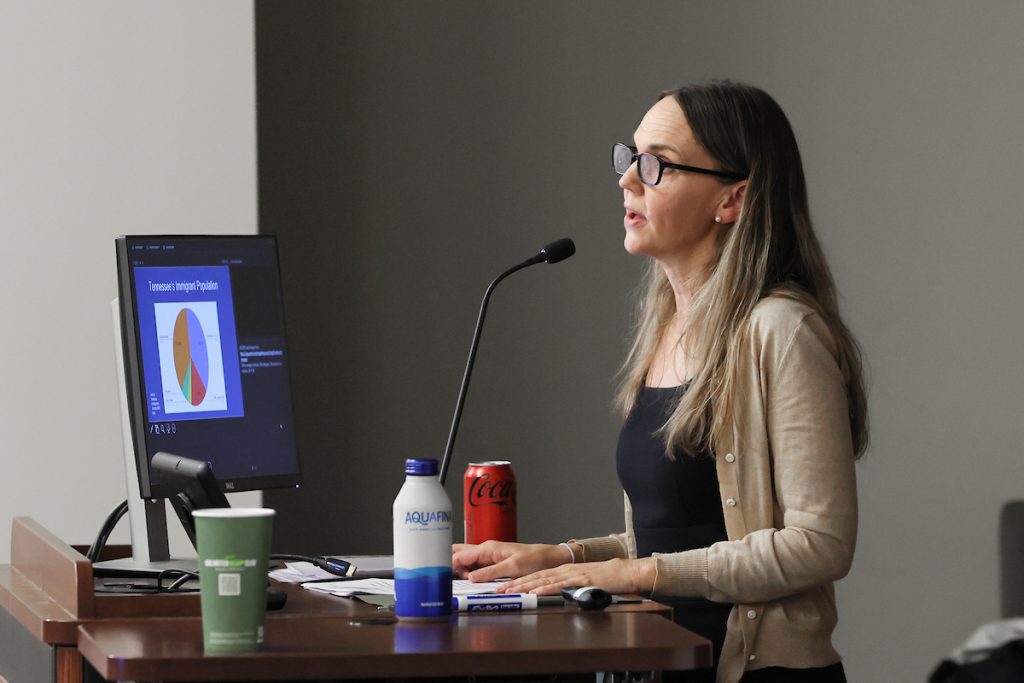
“It’s not an exaggeration to say that our immigration legal system has been upended at every level since January, from reinterpretations of not just existing statutes, but what had also been considered settled constitutional law with regard to the rights of noncitizens in the U.S.,” Miller said.
She added that the rollback has been amplified in Tennessee, where state leaders rapidly created a dedicated immigration enforcement office and advanced dozens of restrictive measures targeting immigrants and local governments that assist them.
“Here in Tennessee, what we’ve experienced since the inauguration in January is a sort of amplification, force multiplier of this federal assault on immigrant rights through the use of state and local authorities and resources,” Miller said.
Immigration Bills in the Tennessee General Assembly
TIRRC tracked more than 30 immigration-related bills in the most recent legislative session, a volume Miller described as “frenetic activity around immigration.” Miller said that among proposals that failed were a bill that stripped undocumented immigrants of legal standing to bring civil actions in Tennessee courts, as well as a bill that mandated the forced transport of undocumented individuals released from local custody into Immigration and Customs Enforcement (ICE) custody or “the nearest sanctuary city within 700 miles of Tennessee.” While these measures did not pass, Miller emphasized that their introduction marked a shift in Tennessee’s legislative tone.
“What I learned this year is that the norms around the treatment of immigrants are shifting very rapidly, such that a proposal that seems outlandish and crazy today can be a very real possibility or even an actuality within months,” Miller said.
Several bills were passed that effectively expanded Tennessee’s role in immigration enforcement. One law creates a cause of action against charitable housing providers if a person they house is later found to be undocumented and commits a crime that harms another. Another invalidates driver’s licenses from other states if those licenses were issued to undocumented residents, with the Tennessee Department of Safety set to publish a list of affected license classes by December 1. A third law establishes a state-level “harboring” prohibition, exposing individuals and organizations to criminal penalties for offering assistance to undocumented residents. TIRRC has joined national organizations in challenging the harboring law on constitutional preemption and vagueness grounds.
The most contentious proposal, Miller said, was a package of three bills seeking to restrict access to public K–12 education for undocumented children. The sponsors of these measures sought to challenge the Supreme Court’s ruling in Plyler v. Doe (1982), the landmark decision guaranteeing free public education to all children regardless of immigration status.
TIRRC responded swiftly by coordinating legal analysis, community mobilization, and public advocacy. In partnership with local educators and immigrant families, TIRRC organized demonstrations at the state capitol aimed at informing lawmakers of the constitutional and moral stakes. The bill package ultimately failed in the House after passing the Senate. Miller noted that the Plyler–related bills may resurface next spring.
“We’re getting prepared to fight for the rights of immigrant kids in Tennessee and across the U.S. to access public education,” she said.
Escalated Enforcement in Tennessee and TIRRC’s Response
Since the legislative session, Miller said TIRRC has seen a dramatic rise in immigration enforcement activity across the state. She recounted the case of a longtime Nashville landscaper who disappeared on his way to work one morning in April, later discovered to have been detained by ICE with no criminal charges. His family located him after days of searching, learning that he’d been transferred between jails in multiple states before facing civil immigration proceedings weeks later.
Miller said this case exemplifies what TIRRC now sees daily. Immigrant workers—often in construction or landscaping vehicles—who were stopped by local law enforcement or the Tennessee Highway Patrol and handed directly to federal agents, with no criminal charges filed and no record of arrest in the state system. Once detained, they were shuttled from jail to jail—first to Putnam County, then Knox County, then to detention centers in Alabama or Louisiana—often without paperwork or notice to their families.
“We’ve heard this scenario over and over again since April,” Miller said.
In early May, as “Operation Flood the Zone” intensified in Nashville, TIRRC’s hotline received more than 1,000 calls in two weeks from families searching for missing relatives. The organization converted its office into what Miller described as a “missing persons call center.”
“We developed a system with other immigration legal services providers in the state to find people in detention,” Miller said. “It was an arduous process because the ICE detainee locator is slow to update. There is an online detainee locator, but it doesn’t recognize somebody in the system until at least 48 hours after they’ve been apprehended.”
Similar enforcement surges have since spread to Memphis under the Memphis Safe Task Force, when federal officers and Tennessee National Guard troops conducted mass street sweeps and made warrantless arrests in Latino and working-class neighborhoods.
In July, a federal judge temporarily barred immigration agents from conducting arrests or stops based solely on a person’s race, ethnicity, or occupation, but the U.S. Supreme Court stayed that injunction in September, allowing federal agents to resume the operations while the case proceeds.
 “For now, the Court has given the green light to race and class-based policing in the immigration context, which is profoundly disturbing for so many reasons, especially because the agencies that enforce immigration laws are expanding very rapidly in staff and budget,” Miller said.
Because there are few nonprofit immigration attorneys across Tennessee, Miller said TIRRC focuses on impact-driven cases that expose broad systemic abuse. The organization has filed constitutional challenges to new state laws, public-records petitions demanding transparency from the Tennessee Highway Patrol, and habeas corpus actions for individuals detained during street sweeps in Nashville and Memphis.
Miller emphasized that the fight for immigrant justice is part of a long continuum of American struggles for equality and that progress comes through collective, sustained effort.
“I think the best description for our approach to legal work at TIRRC is that we are movement lawyers,” she said. “We work alongside our colleagues on organizing, policy, and narrative teams, and in conjunction with our members and constituents to deploy legal strategies to both respond to community needs and build immigrant community power over the long run.”
About the George Barrett Social Justice Program
The George Barrett Social Justice Program was named, endowed, and expanded in honor of George Barrett ’57 in August 2015. Barrett was best known for leading a decades-long and ultimately successful legal battle to desegregate Tennessee’s public institutions of higher learning. The Distinguished Practitioner in Residence program recognizes attorneys who have distinguished themselves in the practice of public interest law and whose experience and perspective will enrich the academic environment.