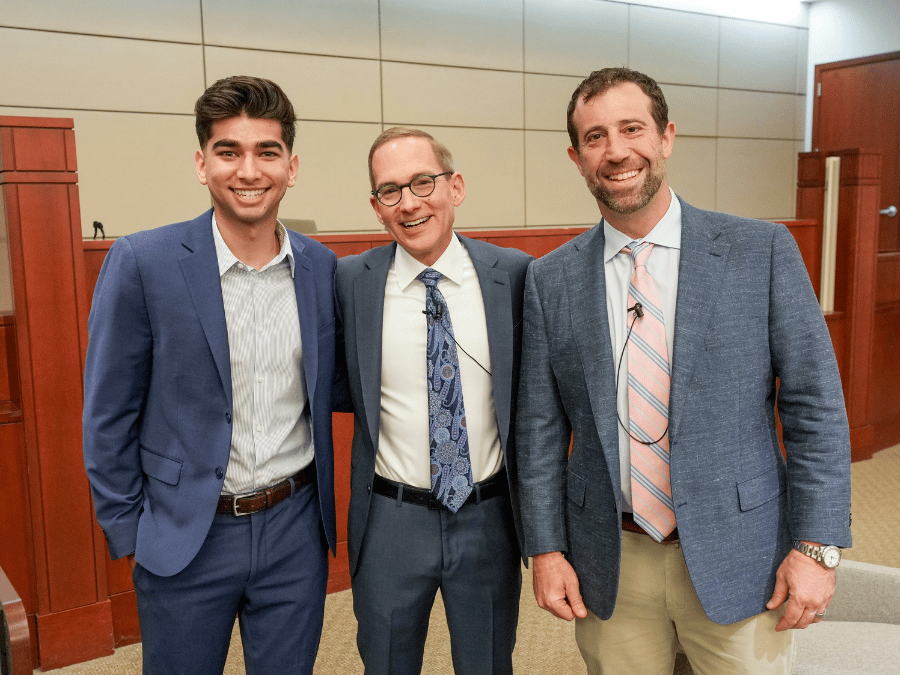
The Vanderbilt Law and Business Society, the Entertainment and Sports Law Society, and the Dean’s Office hosted a fireside chat with Vanderbilt Law alum Justin Ishbia ‘04. Ishbia, who serves on the Vanderbilt Board of Trust, is a founding partner of private equity firm Shore Capital Partners and a part majority or minority owner of four professional sports franchises—the Phoenix Suns, Phoenix Mercury, Chicago White Sox, and Nashville SC. In a conversation with Dean Chris Guthrie, Ishbia reflected on his professional journey through law and business.
Creating a Roadmap
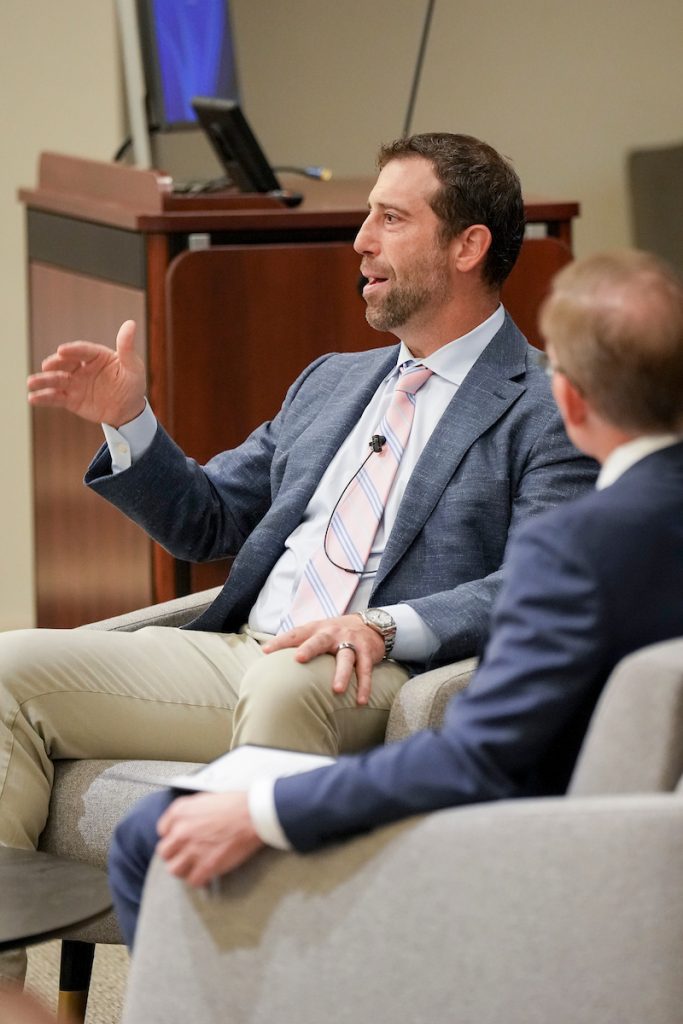 Born and raised in Detroit, Ishbia found that his upbringing and early professional exposure offered a model for an interdisciplinary career. He credited his father, a lawyer, and his mother, a public school teacher, for ingraining in him the work ethic and empathy that shape his approach. “They taught me everything I know about business and being a good person,” he said.
Through visits to his father’s law firm as a teenager, Ishbia learned that legal training could provide a valuable framework for judgment and problem-solving in any career. “My dad was more of a generalist lawyer. I saw him advising, and it’s almost like he was an investment banker-met-lawyer-met-psychologist. I just loved what he was doing. I thought it was so interesting.”
Ishbia first learned about private equity, commonly referred to as “PE,” before his freshman year, during a conversation with a friend’s father, Bob Burgess. The profession intrigued him, but the traditional path to launching a firm – which includes a business school degree and long stints at investment banks and other PE firms – felt too long. “The next day, I came back to him and said something like ‘I don’t want to wait until 45, what can I do?’,” he said.
Burgess’ response ended up shaping his career. “He said that the last skill set a private equity professional learns is the legal art of the deal,” Ishbia recalled. “He said, ‘if you want to have your own firm at a younger age, go learn that first.’”
Following Burgess’ “sage advice,” Ishbia studied finance as an undergraduate and earned a CPA. He originally attended the University of Michigan to play baseball, but an injury sustained before his freshman year eventually compelled him to transfer to Michigan State, where he studied alongside his brother Mat, his “best friend” and now business partner in multiple ventures.
He continued to execute on his plan after graduation, earning his J.D. from Vanderbilt and launching his career at Kirkland & Ellis before transitioning to PE firm Valor Equity Partners. Later, he recruited partners with more traditional PE experience to build a team capable of launching a firm. “You have the legal angle, they have the business-banking angle, and together you have a really straight team,” he explained. From there, Shore Capital Partners was born.
The Art of Process and Preparation
Attending Vanderbilt Law School “was the best decision I ever made,” he said. During his three years in the J.D. program, he worked intentionally toward his long-term private equity goals: tailoring his coursework and extracurriculars, collaborating with classmates, networking with PE firms in Nashville, and earning a certificate in law and business.
“I’m very much a process-driven person to this day. I believe in setting goals and writing them down,” he said. “That’s something that’s been a part of my DNA, that’s part of my intentionality, and I think it helped create success.”
Ishbia reflected on his time as an associate at Kirkland & Ellis, emphasizing that the firm’s mentorship culture, repetition and pace, and volume of knowledge offered him the rigorous training he was seeking relatively quickly. The experience taught him to trust his own legal judgement when facing risks in business.
“Instead of just having legal writing skills, I was always trying to do things multiple years in advance and trying to get myself in a position, so when I got somewhere, I learned quickly,” he said. “I always advise young, talented people that the first six months on the job are the most important for reputation.”
That foundation would later prove indispensable when Ishbia transitioned from law to a private equity firm. The move came with a significant pay cut and uncertainty, but he viewed it as an investment in long-term learning. Success, he explained, was not about the immediate title or compensation but rather gaining the skills and perspective to eventually build something of his own in a career that he valued.
“I think the goal is to learn, get into position, and go down a path toward a career that you love. I think the best people love what they do,” he said.
The Power of Relationships
 Ishbia launched Shore Capital Partners as one of four founding partners at the tail end of the recession in 2009, timing he described as both risky and advantageous. The team raised its first $10 million fund backed by lawyers and local traders in Chicago. Ishbia said that years of intentional relationship-building proved invaluable during fundraising, as many of those early contacts later became investors and advocates of his firm. Word-of-mouth, he said, became the firm’s most effective advertising.
Private equity firms typically seek bigger deals or more numerous deals, Ishbia explained. Shore chose the latter, acquiring small to mid-sized companies in the micro-cap segment which typically generated under $100 million in revenue. Its first investment—a veterinary company—became what Ishbia called the firm’s “poster child,” growing from about $5 million in revenue to $3.2 billion today.
“The idea always was to play a part of the market that very few play,” Ishbia said. “Ninety-five percent of the economy is small and medium-sized businesses.”
That strategy remains central to the firm, which now manages $14 billion in assets across 58 platform companies in sectors such as healthcare, food and beverage, industrials, real estate, and business services. Ishbia attributed much of the Shore’s early growth to reputation and relationships, adding that a consistent internal “playbook,” leadership practices, and investment in young talent continue to guide its expansion.
Sports Ownership and Advice to Students
Ishbia described sports ownership as one of the most rewarding chapters of his career for the priceless experiences it creates, regardless of win-loss records. “You can promise the process, not the outcome,” he said. “Sports, to me, is about milestones and memories with loved ones.”
He encouraged students to stay driven through long-term goals, overcome self-doubt, prioritize mental health, and develop relationships that build personal and professional growth.
“If you don’t have self-doubt, you’re probably not setting high enough goals for yourself,” he said. “Self-doubt, learning other people’s experiences, taking appropriate risks—it’s all intertwined.”
He encouraged students to surround themselves with mentors from different generations, describing it as an “insurance policy” that takes a lot of deliberate effort but offers perspective across life stages. He also reminded students that progress looks different for everyone, dissuading them from measuring their own paths against those of their peers.
“The best mentors won’t tell you what to do,” he said. “They’ll share a story that’s relevant to them, and it’ll help you make your decision.” He added, “Be confident in who you are, but ask for help. I think people want to help you more than you think.”