The inaugural Vanderbilt AI Governance Symposium convened leaders from industry, academia, and government to explore questions surrounding AI accountability, transparency, and governance. The summit’s keynote conversation centered on careers in AI and technology policy, moderated by Professor Mark J. Williams, Co-Director of the Vanderbilt AI Law Lab. The panel featured Sean Perryman, Adjunct Professor and Global Head of AI & Fairness Policy at Uber; Asad Ramzanali, Director of Artificial Intelligence & Technology Policy for the Vanderbilt Policy Accelerator; and Dawn Maruna, Director and Senior Counsel at Palo Alto Networks.
The panelists discussed their nonlinear paths toward technology governance, highlighting how artificial intelligence is reshaping traditional legal practice and career opportunities. They underscored the value of taking well-calculated risks and trusting their capacity to adapt. Transferable skills, they noted, are invaluable for navigating and pivoting within fast-evolving sectors like AI.
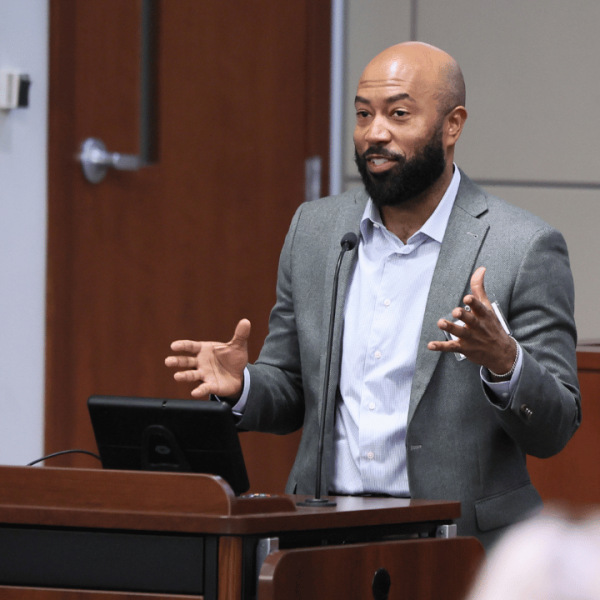
Perryman ‘11 began in litigation before serving as Counsel within the House Committee on Oversight and Reform. There, he managed the technology subcommittee and led the first congressional investigation into facial recognition technology, launching his work on algorithmic bias and AI policy. “Besides betting on yourself, you have to tell your story of who you are and your value,” he said. “Write the article, speak on the thing, promote yourself in some way, because no one else is going to do that for you. That’s going to open up more opportunities.”
Maruna began in IT management and software training before transitioning to law school and entering a career in the contract-heavy field of insurance law. She moved to in-house counsel roles, drafting tech contracts and supporting software development teams, experience she now applies in her role as a privacy lawyer overseeing cybersecurity and AI governance initiatives at Palo Alto Networks. “Our privacy team leads the AI governance for our company,” she said. “Whether it’s the committee, the charter, the policies, the implementation, the training or the assessment, we’re involved in it.”
Ramzanali began his career at Intuit on the corporate strategy team, working at the intersection of technology and law, before helping to launch a financial-technology accelerator aimed at benefiting low-income Americans. After earning a Master’s degree in Public Policy, he worked on Capitol Hill, engaging with committees on technology regulation. He later served in the White House Office of Science and Technology Policy before joining Vanderbilt. “You have to figure out the things you care about and what you’re optimizing for, and that can shift,” he said. “Don’t over-optimize for a seven-step plan. Do the thinking you would do to develop that, figure out your values, figure out the things you care about…But don’t overanalyze the seven-step ‘here’s where I want to be in a decade.’”
Panelists noted that lawyers in the technology sector benefit from developing technical fluency and translation skills, which decreases the barrier of communication across disciplines. While mastering coding isn’t essential, a practical understanding of the software development lifecycle is helpful for designing effective governance and policy solutions. They emphasized that understanding how industry professionals think is crucial, noting that this can be strengthened through credentials like the AI Governance Professional exam, coupled with networking and fundamental soft skills.
“You want to approach them with a beginner’s mindset,” Maruna said. “Really, if you have the basic backbone of understanding the phases they go through, understanding their pain points, understanding their goals, speaking to them about the unique facets of their jobs—I think that’s really great.”
Perryman likened it to deposing an expert witness. “When you first get in, especially as a young associate, you want to look at it like an expert witness,” he said. “Don’t kid yourself that you’re going to become the guru on this topic, but you need to have a fluent understanding of it. You need to really do your research so that you can go in and know the right questions to ask and how to apply your legal training to technology.”
Even small experiments with tools and code platforms can help lawyers grasp the practical limits of technology, Ramzanali said. Professor Williams, who teaches courses on AI legal practice, added that AI governance education is less about mastering a static body of information than about students learning how to recognize their knowledge gaps.
The panel concluded by emphasizing that breaking into AI and technology law often requires strategic relationship-building and continuous learning outside the classroom—through mentorship, professional organizations, public-sector experience, and openness to nonlinear career trajectories.
“Your career isn’t limited to your job,” Perryman said. “Even if you’re at a law firm or you’re at some place where it doesn’t seem immediately obvious how you can get into something else, what you do outside of work matters too, whether it’s a civic organization or bar association, or whatever it may be. There are lots of opportunities to break into different things by expanding outside of your job.”
Watch the keynote conversation from the 2025 Vanderbilt AI Governance Symposium below: