Vanderbilt Law School hosted U.S. Senator Josh Hawley of Missouri for the 2025 Cecil Sims Lecture.
Hawley is serving his second term in the U.S. Senate after a tenure as Missouri’s 42nd attorney general. He graduated from Yale Law School and clerked for Judge Michael McConnell on the U.S. Court of Appeals for the Tenth Circuit and Chief Justice John Roberts on the U.S. Supreme Court. Hawley previously taught constitutional law at the University of Missouri School of Law. He is the author of The Tyranny of Big Tech.
Hawley’s lecture explored the power, risks, and regulation of large corporations through the lenses of antitrust law, private enforcement, and constitutional interpretation. The event was moderated by Brian Fitzpatrick, Milton R. Underwood Chair in Free Enterprise.
Big Tech, Concentrated Power, and Corporate Accountability
Hawley opened the lecture by addressing the concentration of corporate power within the technology sector, which he views as the defining challenge of modern governance. He argued that dominant digital platforms, such as Facebook, possess unprecedented influence over economic activity and political decision-making, often operating as if shielded from legal consequences. Reflecting on his tenure as Missouri’s attorney general, Hawley expressed that “what these companies fear above all is a jury,” asserting that ordinary citizens, rather than regulatory agencies, remain the most effective mechanism for yielding corporate accountability.
He described this as a pivotal realization: private litigation empowers juries to enforce pro-competition guardrails, secure compensation for victims, and compel companies to reform their behavior. “They fear private action. They fear your normal citizen getting into court and telling their story in front of a jury,” he said. “And you know they fear it because they will do anything to prevent it.”
He attributed this dynamic to regulatory capture in federal agencies and the Senate’s subordination to corporate interests — “nothing that Big Tech strongly objects to will move across that floor,” he contended. Corporations have learned to delay or neutralize enforcement efforts, and he positioned private right of action as a democratic corrective.
Hawley likened the current concentration of digital power to the railroad monopolies of the early 20th century. “We’ve seen this before in periods of American history,” he noted. “Our answer every time has been to reassert the authority of the people—to subject these companies to enforcement actions by private parties and others to reintroduce competition. And boy, I think we need to do that today.”
Reviving Citizen Protections and Market Competition
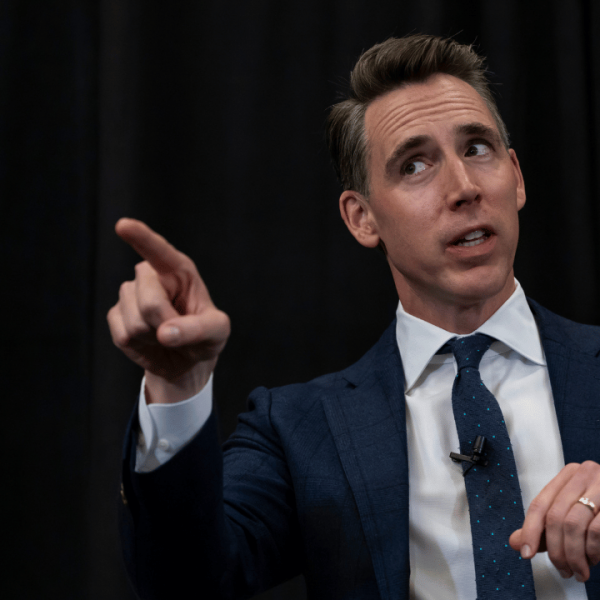 Hawley emphasized the importance of private legal action as a means of both protecting citizens and restoring balance to markets. “Our markets are, in so many industries, historically concentrated. We’re seeing concentration levels that we have not seen for a hundred years,” he said. “If we want innovation, if we want competition, and above all, if you want to protect the little guy, you have got to give the little guy a chance to be heard in court, a chance to have his rights vindicated. And you need an economy where you have robust competition at all levels.”
Drawing from the philosophy of President Theodore Roosevelt, Hawley called for a renewed populist approach to the free market—one that empowers citizens to challenge corporate misconduct directly. He endorsed third-party litigation funding as a mechanism that enables individuals to pursue costly cases against major corporations with the backing of outside investors, diverging from the prevailing stance among his Republican colleagues. The senator criticized recent congressional efforts to restrict such financing, arguing that limiting this access would “close courthouse doors” and erode one of the few mechanisms through which ordinary Americans can hold powerful companies accountable.
Citing the broader Anglo-American legal tradition, he described lawsuits as an essential check within the common-law system. “Companies don’t like to be sued,” he said. “But that’s part of the checks and balances of our system.” He added, “I just think that this fundamental principle of our law, which has been so empowering to the everyday citizen, is something that we want to protect.”
Textualism, Originalism, and the Role of Lawmaking
Turning to constitutional interpretation, Hawley described himself as a textualist and an originalist. “When law is written, it has to be public and understandable,” he said. “Otherwise, it’s not legitimately binding.” He explained that textualism views the law as what is actually written on the page, not what legislators intended to write, while originalism seeks to interpret those words according to their public meaning at the time they were enacted.
“You ask, ‘what did the words mean to the public at the time the law was adopted?’” he remarked. “We fix the meaning of laws that way. Then, if we don’t like them, we change them. That’s what a democracy is.”
Hawley contended that Congress often writes vague or overly broad statutes and then delegates interpretive authority to federal agencies. He warned that such legislative habits erode democratic accountability and expand administrative power. He also maintained that lawmaking must remain in the hands of elected officials, not judges. It is a messy and inefficient process, he said, “but efficiency is not our Constitution’s greatest value—liberty is.”
“Preserving that liberty for every person in this country, and preserving it especially for people who otherwise don’t have a voice, is much the burden of everyone in elected office and frankly all of us as attorneys.”
Watch the full discussion here or on our YouTube Channel:
About the Sims Lecture Series
The lecture series honors Cecil Sims, a 1914 first-honor graduate of Vanderbilt Law School and a founding member of the Nashville-based firm of Bass Berry & Sims. The series was established to welcome leading legal figures to campus for candid conversations with students and faculty. Over the years, the Sims Lecture has hosted prominent jurists, including Supreme Court Justices Neil Gorsuch, Clarence Thomas, Sonia Sotomayor, Antonin Scalia, and Sandra Day O’Connor, as well as Attorney General Eric H. Holder Jr.